Biggest Intel Arc B580 Buying Mistakes (And How to Avoid Them)
The Intel Arc B580 has appeared in more midrange laptops and OEM configurations, promising modern hardware-accelerated media features, XeSS upscaling and hardware ray tracing support. For buyers who want a solid mix of gaming, streaming and content creation on a budget, it looks appealing on paper. However, purchasing a laptop with an Intel Arc B580 without doing the right checks can lead to disappointment: poor thermals, uneven driver behavior, or a mismatch between expectations and real-world performance.
This article outlines the most common buying mistakes people make when shopping for an Arc B580-equipped laptop, explains the real-world implications, and provides a practical guide to avoid them. It covers typical use cases—1080p gaming, light 1440p play, streaming, video editing, and productivity—and gives an editorial analysis to help readers decide whether an Arc B580 configuration is the right choice.
Understanding what the Intel Arc B580 is (and what it isn’t)
The Arc B580 is positioned as a midrange mobile GPU in Intel’s Arc family. It targets mainstream gaming at common laptop resolutions and offers the same software ecosystem that defines Intel’s discrete GPU efforts: support for hardware AV1 encode/decode, the XeSS upscaling technology, and DirectX 12 / Vulkan feature sets including ray tracing. Buyers should treat the B580 as a component of a wider system—its real-world value is strongly influenced by the laptop’s cooling, power delivery, display, and the driver state.
Key buyer takeaways at a glance: the B580 usually aims for reliable 1080p performance in modern titles and useful hardware encoding for streamers and content creators. It is not a high-end desktop replacement GPU; buyers seeking maximum 4K performance, the fastest ray tracing, or extreme workstation compute will find more appropriate options elsewhere.
Most common buying mistakes — and the consequences
Mistake 1 — Buying based on model name alone
Many buyers assume a specific GPU label guarantees a fixed level of performance. With mobile GPUs this is not true: the same Intel Arc B580 label can be configured in different laptop builds with different power limits (plotted as TGP/TBP), clock targets and thermal headroom. That means two laptops listing "Arc B580" can perform quite differently.
Consequence: buying a thermally constrained or low-power SKU results in lower sustained frame rates, more frequent throttling, and worse performance in multi-threaded workloads.
Mistake 2 — Ignoring TGP/TBP and cooling design
Power limits and cooling are the single biggest determinants of sustained GPU performance in laptops. Assuming the B580 will run at its peak spec without checking the laptop’s cooling capability or the committed GPU power budget leads to an unpleasant surprise: tests that show high initial frame rates that collapse after the first few minutes of gameplay.
Consequence: poor long-term gaming performance, higher CPU temperatures, reduced battery life, and more fan noise than expected.
Mistake 3 — Expecting flawless driver parity with NVIDIA/AMD
Intel’s driver story improved substantially since the Arc launch, but driver maturity and game-by-game optimizations can still be variable compared with decades-old NVIDIA or AMD ecosystems. Buying under the assumption of identical stability and optimization across all games or creative apps can be a mistake.
Find top-rated Laptops & Computers products at great prices.
View Offers →Consequence: occasional graphical glitches in specific titles, differing performance in older or niche engines, and the need to wait for driver updates for some fixes.
Mistake 4 — Overestimating ray tracing and upscaling results
Ray tracing hardware is present, and XeSS provides upscaling. But the net result depends on driver tuning, per-game XeSS profiles, and the laptop’s display resolution. Expecting RTX 40-series-level ray tracing at equivalent frame rates or identical upscaling artifacts is unrealistic.
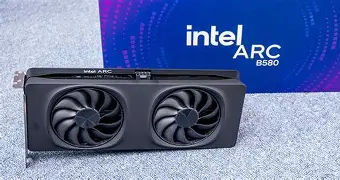
Consequence: poor performance when enabling ray tracing at high fidelity settings unless the game supports effective XeSS profiles; disappointing visual results if expectations are set by flagship comparisons.
Mistake 5 — Not checking AV1 encoding support and streaming workflows
One of Intel’s strengths for Arc GPUs is modern media support. However, not all laptop vendors expose every media feature the same way in their OEM firmware or driver stacks. If a buyer relies on hardware AV1 encoding for streaming or efficient video export, it is essential to verify that the chosen laptop’s drivers and capture software correctly expose the AV1 encoder.
Consequence: having to fall back to older codecs (x264/x265), higher CPU load while streaming, or lower streaming quality for a given bitrate.
Mistake 6 — Buying a display that the GPU can’t drive well
Pairing the B580 with a high-resolution or ultra-high-refresh display creates a mismatch: many midrange GPUs shine at 1080p and can handle 1440p in certain games, but 4K or 240Hz 1440p gaming will often be out of reach. Buyers sometimes choose laptops with a flashy 144Hz 1440p or 4K panel without considering the realistic frame rates the GPU will produce.
Consequence: wasted display potential, increased power draw, and disappointment when desired frame rates at native resolution aren’t achievable.
Product analysis: where the B580 fits in real-world use cases
To evaluate whether the Arc B580 is right for a buyer, it helps to look at how it performs across common scenarios.
1080p gaming (casual / AAA at medium–high settings)
The Arc B580 is typically well-suited to 1080p gaming at medium to high settings. For esports titles (CS:GO, Valorant, Rocket League) the B580 usually delivers high frame rates that make good use of high-refresh displays. For modern AAA titles, expect medium to high settings with fluctuating frame rates; enabling ray tracing will reduce frame rates and should be considered selectively along with XeSS where available.
Looking for the best Laptops & Computers deals on Amazon?
Shop Amazon →1440p gaming and higher-refresh panels
For consistent 1440p gaming, the B580 may struggle in demanding modern titles unless settings are reduced or XeSS is used. If a buyer prioritizes high-refresh 1440p gaming, confirming the laptop’s TGP and real-world benchmarks is essential; otherwise a configuration with a higher-tier GPU might be preferable.
Streaming and content creation
Thanks to hardware AV1 support in recent Arc hardware and an efficient video encoder, the B580 can be attractive to streamers and creators—provided software and drivers fully expose AV1 encoding. For everyday video editing, the B580 can accelerate timeline playback and exports in apps that properly leverage Intel media SDKs or hardware acceleration paths; heavy professional workloads that require optimized CUDA support will still favor NVIDIA-based machines for certain apps.
Productivity, light compute and CAD
For office work, photo editing and light 3D or CAD tasks, the B580 is more than capable. Buyers doing occasional rendering or engineering tasks should check application compatibility—some professional tools are optimized for specific GPU vendors.
How to avoid the mistakes: a practical buying checklist
- Verify the laptop’s GPU power/TGP — Look for published TGP or TBP numbers in reviews or technical specifications. If the vendor does not disclose them, consult reputable reviews or ask the seller. Higher TGP means higher sustained performance, all else equal.
- Read independent reviews and thermal tests — Look for reviews that include sustained gaming benchmarks, thermal imaging, and power draw. Short peak FPS numbers are not indicative of long-run performance.
- Confirm driver and software support for AV1 and XeSS — Check whether the streaming and editing tools to be used (OBS, Adobe Premiere, DaVinci Resolve) have known compatibility or recommended driver versions for Intel Arc AV1 and hardware acceleration.
- Match display to use case — Prefer 1080p 144Hz or 1440p 60–120Hz displays depending on gaming preferences. Avoid buying a 4K or very high-resolution panel unless planning to do non-gaming work where resolution benefits matter more than framerate.
- Consider CPU and RAM pairing — A capable GPU requires an adequately powerful CPU and sufficient RAM (16GB is a practical baseline for gaming + streaming). Bottlenecks in CPU can mask GPU potential.
- Check OEM BIOS limitations and driver bundling — Some OEMs lock driver options or delay driver updates. Prefer vendors with a track record of timely driver support and BIOS updates.
- Inspect I/O and connectivity — For multi-monitor setups, external capture cards, or eGPU options, ensure the laptop exposes necessary ports (DisplayPort/HDMI, Thunderbolt/USB4 where applicable).
- Budget for long-term software updates — Factor in that driver optimizations often improve performance over months; if immediate top-tier performance is needed, verify testing done with current drivers.
- Test before finalizing purchase — When possible, test the machine in-store or through an extended return policy, running the specific games and workloads the buyer cares about to evaluate real performance and thermals.
Pros & Cons
- Pros
- Modern media features: hardware AV1 encode/decode and up-to-date codec support make it efficient for streaming and video export in supported workflows.
- XeSS upscaling provides an additional lever to trade quality for performance in supported games.
- Competitive midrange performance for 1080p gaming and everyday creative tasks at reasonable price points.
- Driver improvements have been consistent, reducing earlier stability gaps with major titles.
- Cons
- Performance varies significantly across different laptop implementations because of TGP and cooling differences.
- Driver maturity, while better, can still produce game-specific issues requiring updates or workarounds.
- Not the best choice for workflows that depend heavily on vendor-specific accelerated libraries (e.g., CUDA-only workflows).
- Ray tracing performance lags behind higher-end NVIDIA and AMD offerings at comparable visual settings.
How the Arc B580 compares to alternatives — a qualitative table
| Aspect | Intel Arc B580 (what to expect) | Typical NVIDIA/AMD alternatives (general) |
|---|---|---|
| Gaming at 1080p | Good: reliable medium–high settings. Strong in esports titles. Use XeSS for extra headroom. | NVIDIA/AMD offer broader driver maturity and often slightly higher fps at similar power; ray tracing usually performs better on NVIDIA high-end parts. |
| Ray tracing | Supported, usable at modest settings. Expect larger performance drops versus rasterized rendering. | NVIDIA’s RT hardware and larger ecosystem currently provide stronger ray-traced performance and game-specific optimizations. |
| Media & streaming | AV1 encoding is a major advantage for efficient streaming bandwidth and future-proofing where software supports it. | NVIDIA also offers strong encoders (NVENC) with wide software support; AV1 hardware encode adoption is increasing across vendors. |
| Driver stability & ecosystem | Maturing: many fixes and features added since launch, but occasional title-specific quirks remain. | NVIDIA and AMD benefit from long-established developer relations and broader software certification for some professional applications. |
| Value | Often good value in midrange laptops, especially when thermal and power are adequate. | Value varies; sometimes more expensive but with stronger long-term driver optimization in favor of alternatives. |
Real-world checklist before buying
Before clicking buy, run through these checks specific to an Arc B580 laptop:
- Find sustained thermal/power numbers: Look for reviews that show sustained FPS, GPU power draw, and surface temperatures during long sessions.
- Confirm AV1/XeSS support in target software: Search knowledge bases or release notes for OBS plugins, Adobe, or other apps to ensure hardware encoding is exposed.
- Ask about BIOS/driver update policies: Choose vendors known to update drivers and firmware promptly.
- Compare panel choice to intended use: If the buyer will game, a 1080p high-refresh panel often yields the best experience; for photo/video work, a higher-res calibrated panel is more useful.
- Check return policy: A comfortable return window allows hands-on testing with the buyer’s own apps and games.
- Search community forums for that exact model: Often early adopters report model-specific quirks like fan control behavior or driver package differences.
Final thoughts and conclusion
The Intel Arc B580 represents a pragmatic midrange GPU choice in laptops—one that offers modern media features and sufficient gaming prowess for most 1080p scenarios. The most frequent buyer mistakes revolve around assuming consistency across laptop designs: power limits, thermal implementation and OEM software choices matter more than the GPU name on the spec sheet. Driver expectations should be managed too: Intel has made meaningful progress, but compatibility nuances remain.
To avoid disappointment, buyers should validate the laptop’s sustained performance via trusted reviews, confirm media and streaming support where needed, and match display resolution and refresh rate to the GPU’s realistic capabilities. When these checks are done, an Arc B580 machine can deliver excellent day-to-day value—especially for streamers and creators who can leverage AV1 and XeSS—without the surprises that come from shop-floor impulse purchases.
In short: buy the Arc B580 for the right reasons, with the right research. Avoid buying it for a model name alone; instead, evaluate the whole system and how it aligns with the buyer’s real-world workloads. That approach will save money, time, and frustration while delivering a laptop that meets expectations.