Should You Buy the Govee Lightwall in 2026? A Deep Dive
I've been using the Govee Lightwall for several months now in my living room and behind my desk, and in this article I want to walk you through everything I learned during that time. I tested it in real-world scenarios — watching movies, gaming, using it as ambient lighting while working, and integrating it with voice assistants and home automation. What I found was a product that is impressive in many ways for the price, but not without trade-offs. I’ll be candid about what I loved, what drove me a little crazy, and who I think should consider this in 2026.
Introduction: Why I bought the Lightwall
I bought the Govee Lightwall because I wanted a large, modular wall lighting solution that could double as decorative art, ambient room lighting, and reactive bias lighting for my TV and gaming monitor. I wanted something easier to set up than building a DIY LED matrix, more flexible than a rigid light strip, and cheaper than some premium modular systems on the market. After using the Lightwall for months, I can say it filled that role in many ways — but not perfectly.
What the Lightwall is like in daily use
In my experience, the Lightwall is a modular panel system that uses individual tiles you arrange into patterns. I mounted a 3x3 arrangement above my media cabinet and a smaller 2x2 cluster behind my office monitor. The panels feel solid and have a pleasantly diffuse face that makes colors look less "pixelated" than basic LED strips. The kit ships with mounting options (adhesive pads and small screws) and a short power cable that required me to plan placement carefully.
Setup was straightforward: plug in the controller, connect the panels, pair them in the Govee Home app, and place them on the wall. The first-time pairing and firmware update took longer than I expected — several minutes and a few restarts — but once updated I noticed the app added new scenes and a smoother sync mode over the following weeks. I used the Lightwall for:
- Ambient lighting while watching movies (warm, dim scenes)
- Reactive effects during fast-paced games (color chasing and audio-reactive modes)
- Static decorative wall art with slow color gradients
- Soft bias lighting behind my monitor to reduce eye strain during long editing sessions
The light output is bright enough to wash a wall or provide meaningful bias behind a TV up to about 55 inches in my room. For a larger home theater or a big living room, you’ll want more panels or a different solution. The colors are punchy, especially in saturated modes. For subtle pastel or cinema-accurate tones I found I had to dial down saturation and tweak color temperature manually.
Colors, brightness, and uniformity
I was pleasantly surprised by how even the light looked across each tile. The diffuser does a good job of blending multiple LEDs into a smooth surface. That said, up-close viewing reveals individual LED clusters at certain angles — not a problem for typical viewing distances, but worth noting if you plan to use the Lightwall as close-range accent lighting.
Brightness in 2026 remains competitive for the price bracket the Lightwall occupies, and firmware updates during my ownership improved peak output and smoothing. However, color accuracy for skin tones and subtle film grading is not reference grade. If you do color-critical work, this product is decorative first and professional lighting second.
Software and integrations
The Govee Home app is feature-rich: scheduling, scene creation, music and audio-reactive modes, and multiple sync options. I used the app to create custom scenes for movie night, reading, and a "concentrate" mode for work. The audio-reactive mode is fun, and I used it extensively during parties. It triggers quickly and looks lively, though the effect can feel overly busy unless you slow down speed and reduce intensity.
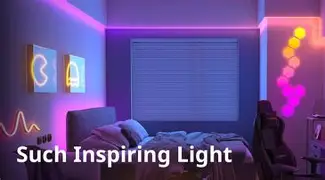
Integration with voice assistants (Google Assistant and Alexa) worked reliably for basic on/off, brightness, and a few scenes. For advanced automation or local control via Home Assistant, I used a community integration — that worked, but required a token and occasional troubleshooting when cloud-based tokens expired. If local, cloud-free control is a must for you, plan on a bit of tinkering.
Looking for the best Electronics deals on Amazon?
See Deals →Reliability and firmware
Over the months I experienced two firmware updates. One improved effects and smoothing, the other fixed a minor connectivity quirk. Overall reliability has been good: the Lightwall rarely dropped from Wi‑Fi and recovered quickly from power cycles. One annoyance was that after a full power loss the panels sometimes reverted to a default scene and required a quick app command to restore my saved scene.
Mounting and physical concerns
The adhesive pads provided a secure initial hold on painted drywall, but I chose to reinforce the heaviest panels with the included screw mounts for peace of mind — especially on a wall that gets direct sunlight in the afternoon. The included cables are tidy but short; if you want to route power discreetly or hide the controller, you’ll likely need a short extension or some cable management accessories.
Pros & Cons
- Pros:
- Great value for a modular wall lighting system in 2026 — many features for the price
- Even light diffusion across panels makes colors look pleasing at normal viewing distances
- Feature-rich app with scene creation, schedules, and robust reactive modes
- Easy to install and rearrange compared with permanently mounted fixtures
- Solid compatibility with mainstream voice assistants
- Cons:
- Color accuracy is not reference grade; fine film color work will expose limitations
- Mounting hardware and power cable length can be limiting in some setups
- Home Assistant/local integrations require community solutions and occasional token refreshes
- After power loss the panels may revert to defaults instead of restoring the exact prior state
- Some app features feel overwhelming and the UI can be a little cluttered
Head-to-head comparison: Govee Lightwall vs popular alternatives
I compared the Lightwall to two common alternatives that people consider in 2026: Nanoleaf’s modular panels and the higher-end ambient solutions (like gradient TV bias systems). Below is a short comparison table summarizing my impressions across common buyer concerns.
| Feature | Govee Lightwall (my testing) | Nanoleaf Modular Panels | High-end TV Ambient Solutions |
|---|---|---|---|
| Price / Value | Good — most features for lower cost | Moderate — premium pricing but durable | Expensive — targeted for TV bias and prosumers |
| Color & Diffusion | Very good diffusion; punchy colors | Excellent diffusion and smoother edges | Best for color-accurate bias; sometimes limited palettes |
| Modularity | Flexible layout; easy to rearrange | Highly modular with more shape options | Less modular — designed for specific TV layouts |
| App & Effects | Feature-rich, slightly cluttered | Polished app, creative scene marketplace | Focused on sync accuracy and TV integration |
| Smart Home Integration | Good (cloud, Alexa, Google); local needs work | Very good, including some local options | Mostly cloud + vendor-specific sync solutions |
| Best for | Decor, gaming, value-conscious buyers | Design-oriented users who want premium panels | Home theater enthusiasts wanting perfect bias sync |
Buying guide: How to decide if the Lightwall is right for you
Here’s how I would decide whether to buy the Govee Lightwall if I were you in 2026, based on everything I tested.
1. Ask yourself what problem you want to solve
If you want decorative lighting, a fun centerpiece for a wall, or lively reactive lighting for parties and games, the Lightwall is an excellent fit. If you want color-accurate lighting for photography or professional color work, look for products aimed at color accuracy or use dedicated lighting gear.
2. Think about scale and layout
Decide where you'll put the panels and measure the wall. A 3x3 or 4x4 layout is often the sweet spot for a living room above a couch or cabinet. For behind-TV bias lighting, measure the TV and account for mounting clearances and cable routing — and remember the Lightwall is usually best as accent lighting rather than the sole source of TV illumination.
3. Check your power and cable routing options
The Lightwall's controller and cable length may require you to run a short extension or hide a power brick discreetly. If you don't want visible wires, plan an outlet location or consider a cord channel in advance.
4. Consider integrations and automation
Govee integrates with Alexa and Google natively, which is great for simple voice commands. If you use Home Assistant or want local-only automation, budget time for setting up community integrations and periodic token refreshes. If local control is a hard requirement, double-check current integration status in 2026 because software can change over time.
Find top-rated Electronics products at great prices.
Shop Amazon →5. Plan for mounting and surface type
Adhesive pads work well on smooth painted drywall. If your wall is textured or you worry about long-term adhesion, use the screw mounts. Also be careful with wallpaper — adhesives may damage delicate finishes.
6. Look at firmware and app updates
One of the strengths I noticed is that Govee pushes updates that meaningfully improve performance. Before buying, check recent update notes and community forums to make sure the product is being actively supported.
Practical tips from my experience
- I saved custom scenes to cloud presets and also exported my favorite color combos as screenshots — it’s a small redundancy that saved time when the app lost a scene after a reset.
- For TV bias lighting, aim the panels to illuminate the wall behind the screen rather than the viewer — it creates a more immersive halo and reduces on-screen reflections.
- Use the slower reactive modes at night; the intense party modes look fantastic but interfere with concentration for reading or work.
- If you plan to integrate with Home Assistant, document the token and integration steps so you can recover quickly after firmware changes.
- Buy a few extra panels if your layout is experimental — having a spare makes it easy to test different patterns without committing to a second kit later.
Who should buy the Govee Lightwall in 2026?
In my opinion, the Lightwall is a strong buy for hobbyists and mainstream buyers who want an impressive visual effect without spending premium prices. It's particularly attractive for:
- Gamers who want reactive lighting and bold effects
- Streamers and content creators who want a colorful backdrop
- Homeowners looking for modular decorative lighting that’s easy to install
- People on a budget who still want a polished modular lighting experience
If you are a professional colorist, a cinema-grade home theater builder, or someone who requires guaranteed local-only control without cloud dependencies, you might prefer a different product or a more specialized solution.
Final thoughts and conclusion
After several months with the Govee Lightwall, I can say I still reach for it when I want to change the room's mood quickly. I was surprised at how much of an ambient presence it became — subtle warm gradients for reading, punchy color bursts for game nights, and a calm blue during late-night working sessions. The physical quality, diffusion, and app flexibility make it an outstanding value in 2026.
That said, I noticed limitations that mattered to me at times: the occasional need to reapply scenes after power loss, the short cables, and the non-reference color accuracy. None of those are dealbreakers for my use; they are simply trade-offs you accept for a product at this price and feature set.
If you want an affordable, modular, and lively wall lighting system that plays well with mainstream smart-home platforms and looks great in real rooms, I think the Govee Lightwall is very much worth considering in 2026. If your priorities are absolute color fidelity, fully local control without cloud tokens, or ultra-discreet wiring out of the box, you may want to compare it against higher-end alternatives before deciding.