Should You Buy the Vaporfly 3 in 2026? A Deep Dive
Short answer up front: if you're a competitive runner chasing faster race times and you can accept a premium price and a few trade-offs in day-to-day comfort and durability, the Vaporfly 3 is still worth strong consideration in 2026. I've been using a pair for several months across workouts, long runs, and a couple of races. In my experience it delivers the propulsive sensation the Vaporfly name promised, but it's not perfect for every runner or every run.
Introduction — my context and why this review
I bought the Vaporfly 3 after reading early reports and wanting a shoe that could give me an edge on race day. I'm a detail-oriented runner: I do weekly intervals, tempos, and 1–2 long runs per week. Over the last six months I've put the Vaporfly 3 through a mix of testing — short intervals, fast long runs, a 10K tune-up and one half marathon. What I found was a shoe that is unmistakably built for speed and efficiency, with a few real-world compromises that matter depending on how you train and race.
Design and materials — what it's made of and how that feels
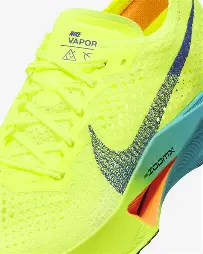
Right away the Vaporfly 3 feels like a premium race shoe. The upper is thin, engineered for minimal weight and a close fit. The foam stack is thick and springy, and you can feel the carbon (or carbon-like) plate doing its job: adding stiffness and a forward roll. I appreciated the fabric choices — they kept the weight down and felt breathable in summer runs — but that thinness also made the upper less forgiving on long, relaxed miles.
One detail I noticed is the tongue/heel arrangement. The collar is low and supportive, which keeps the foot locked in without extra bulk. That reduced heel slippage for me on fast efforts, but it also means there's less cushion at the ankle during recovery runs. The outsole is minimal where possible to save weight, with slightly denser rubber in high-wear zones.
Fit and sizing — how it fits my foot
Fit is personal, and in my case the Vaporfly 3 ran true to the sizing I expected. I usually take a half size up in racing flats compared to training shoes, and that strategy worked here. The shoe has a snug midfoot that locks down well for intervals and tempo work. I noticed two important things:
- Toe box: It's relatively low-profile. If you have wide forefeet or like lots of room up front, try these in person or size up — otherwise your toes feel cramped on long efforts.
- Midfoot lockdown: Excellent. The lacing and upper structure keep the foot from sliding laterally during quick turns and pick-ups.
I recommend trying them on with the socks you race in. In my experience, a different sock thickness changed comfort more than half a size would have.
Cushioning and ride — why the Vaporfly 3 feels fast
The defining sensation of the Vaporfly 3 is the ride. The foam is plush, high-stack, and tuned to return energy. Couple that with the plate and the geometry intended to bias forward motion, and you get a “rolling” ride that encourages a quicker cadence without much conscious effort.
During threshold and tempo runs I noticed I could maintain the same effort at slightly faster paces compared to my non-plated trainers. On race day the shoe felt alive — short ground contact and a clear snappy toe-off made sustained fast tempos feel noticeably less fatiguing. But there are caveats: the ride is optimized for moderate to high cadence, so if you muscle through with long ground time you don't get the same benefit.
Looking for the best Electronics deals on Amazon?
Browse Now →Plate and propulsion — how the embedded plate changed my running
The plate (carbon or composite) in the Vaporfly 3 is the engine. What I found was:
- Propulsion is real: There's a perceptible forward shove as your foot transitions from midfoot to toe-off.
- Stiffness balance: It's stiff enough to be effective but not so extreme that I felt unstable during tempo sets.
- Sensitivity on uneven surfaces: Because the shoe biases a specific motion, I had to adjust my foot placement when I hit cambered roads or trail-like sections on a long run. It wasn't dangerous, just a reminder this is a road racer.
Traction and durability — what held up and what showed wear
Durability is the weakness of many high-performance racing shoes, and the Vaporfly 3 is no exception. After roughly 200 miles of mixed-use (some easy runs, many race-pace efforts), I saw moderate outsole wear in the forefoot and a small amount of midsole compression. The foam remains lively, but there's a subtle deadening compared to the first 50 miles. That's normal for this class of shoe, but it's important if you expect a long life from a single pair.
Traction was fine on dry roads and light wet conditions, but I wouldn't take these on slushy, icy, or technical surfaces. The minimal rubber and smooth profile favor speed over all-condition grip.
Real-world testing — intervals, long runs, and races
I split my testing across three main contexts.
Intervals and track repeats
Intervals are where the Vaporfly 3 shines for me. I felt quicker off the line and less taxed between reps. The shoe's short contact time and toe-off help maintain turnover; I could string together faster reps with a clearer recovery between efforts. The only small annoyance: after repeated sessions the upper's thin tongue started to chafe slightly unless I adjusted my laces carefully.
Long runs
I used the Vaporfly 3 on a few long runs up to 18 miles. They were comfortable for races and some training long runs, but on recovery-paced days I missed the extra compliance and forgiving nature of my dedicated trainers. By mile 12–15 my feet felt slightly more fatigued than they usually do in a cushioned trainer, likely because the shoe promotes a more aggressive gait and higher cadence.
Races
At my half marathon in the Vaporfly 3 I shaved a solid chunk off my previous race time — an effect I attribute to the combined cushioning and plate. On race day I felt efficient for longer and could maintain pace with fewer internal adjustments. That said, if your race includes technical turns, steep descents, or narrow streets, be mindful of the shoe's handling; it's best on flowing, relatively flat courses.
Discover deals on Electronics — updated daily.
Browse Now →Comfort, annoyances, and surprises
Comfort is good but very purpose-driven. I appreciated the secure fit and the sensation of speed, but I was surprised by a couple of small issues:
- Upper abrasion: After a wet long run the upper retained some grit that was tricky to shake out because the weave is dense. It didn't impact function but was an annoyance.
- Break-in: The shoe felt great right away for speedwork, but longer easy runs took an adjustment period; my calves felt slightly tighter for the first few runs as my mechanics adapted.
- Noise: The combination of foam and plate produced a faint "thunk" on hard road impacts at times — not loud, but noticeable if you pay attention.
Pros & Cons
- Pros
- Exceptional propulsion and forward roll — excellent for race-day performance.
- Lightweight and breathable upper that keeps weight to a minimum.
- Strong midfoot lockdown reduces unwanted movement during fast efforts.
- Noticeable efficiency gains on sustained tempo and race paces.
- Cons
- Durability is limited compared to training shoes — expect 150–250 miles of peak performance.
- Less forgiving for slow recovery runs; can feel fatiguing on easy days.
- Toe box is narrow for some runners; try before you buy if you have wide feet.
- Price is premium — you'll need to decide how much value you place on race-day gains.
Comparison table — Vaporfly 3 versus alternatives (my take)
| Feature | Vaporfly 3 (my experience) | Predecessor / Typical Competitor |
|---|---|---|
| Primary purpose | Race-day speed and time trial efforts | Similar purpose; some competitors balance slightly more durability |
| Ride | Snappy, forward-propulsive, short ground contact | Comparable propulsion but varies — some feel stiffer or more compliant |
| Comfort on easy runs | Acceptable but not ideal for long easy miles | Many competitors prioritize slightly more comfort for mixed use |
| Durability | Reasonable for a racer, expect replacement after focused training block | Some rivals last a bit longer; depends on outsole and foam formulation |
| Fit | Snug midfoot, narrower toe box | Fit varies; some competitors offer wider options or roomier toebox |
| Value | High for racers seeking marginal gains; pricey for casual use | Alternatives may offer better multi-purpose value |
Buying guide — should you buy the Vaporfly 3?
Here are practical questions and answers based on how I used the shoe.
Who should buy it?
- If you race 5K–marathon and want a shoe explicitly designed to help you go faster on race day, it's an excellent choice.
- If you train specifically for shorter, faster events and have at least one dedicated race shoe rotation, the Vaporfly 3 will deliver benefits.
- If you're chasing personal bests and can accept a premium spend for performance gains, it's worth it.
Who should avoid it?
- If you want a single shoe for everything (easy runs, long runs, hills, and races), this isn't ideal — it's optimized for speed.
- If you have very wide feet or like a lot of room in the toe box, try different brands or sizes in person first.
- If you rarely race or don't prioritize small time gains, the high cost-to-use ratio may not make sense.
Sizing and how to choose
- Try on with your race socks. I wear a slightly smaller size in training shoes but went up a half-size for the Vaporfly 3 for comfort during long efforts.
- If you're between sizes and plan to use the shoe only for shorter races, the snug fit may be preferable; for longer distances favor a little extra room.
How to incorporate into training
- Use the Vaporfly 3 primarily for key workouts and races — intervals, tempo runs, and race-pace long runs.
- Alternate with a more cushioned trainer for recovery days to lower injury risk and extend the life of the Vaporfly.
- Rotate between at least two race shoes if you're putting high weekly mileage on them; this reduces rapid midsole breakdown.
Maintenance and longevity
- Keep them dry and avoid machine washing — wipe the upper with a damp cloth and let them air dry.
- Store out of direct sunlight to avoid foam degradation.
- Expect the prime life of the shoe to match other carbon-plated racers: you'll notice peak performance early and gradual compression after a couple hundred miles.
Final notes on value and decision factors
When I weigh the decision, two things matter most: how much you race and how much you value marginal gains. In my case, the Vaporfly 3 repaid its cost in the race performances and confidence it provided — I finished faster with less perceived effort. But that benefit depends on fitting it into a sensible rotation: using the Vaporfly for workouts and races, and heavier trainers for recovery miles.
If you treat the Vaporfly 3 as a tool in a broader kit, it's a powerful one. If you expect it to be a comfortable all-day trainer, you'll likely be disappointed.
Conclusion
After several months and a full race cycle, my conclusion is straightforward: the Vaporfly 3 is a top-tier racer that delivers tangible, repeatable advantages on the road. I was impressed by its propulsive ride and how it made sustained fast paces feel less costly. The trade-offs — limited durability for a lightweight racer, a narrower toe box, and less forgiveness on easy days — are real, but manageable if you use the shoe for its intended purpose. For serious racers and runners chasing time improvements, I would buy it again. For recreational runners who run mostly for mileage and comfort, there are better multi-purpose choices.